
Perp DEX Farming in 2026: Where the Edge Still Is
There are now more perp DEXs than anyone can realistically farm properly. Being early still matters, but points only become valuable if the project survives, attracts real traders and eventually rewards users fairly. So I'd rather focus on a smaller group of platforms I think can actually become serious trading venues.
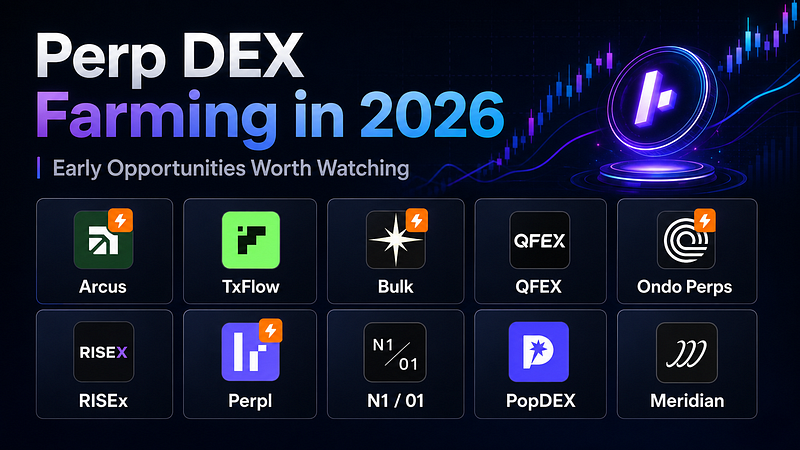
Perp DEX Farming in 2026: Where I Think the Edge Still Is
There are too many perp DEXs now to realistically farm everything.
And I don’t think the answer is to spread capital across 20 platforms just because they all have points.
Points only matter if the project survives long enough to actually reward users in a meaningful way.
So I’m becoming more selective. I’m looking at the team, liquidity, product, traction, technology, security and how early the opportunity still is.
This isn’t a prediction of the winners or the biggest airdrops. It’s simply where I’m spending time and testing things right now.
OI and volume figures are approximate snapshots from August 2026 and can change quickly.
My Current Perp Watchlist
Platform | Tier | Stage | OI | 30d Volume | What Stands Out |
|---|---|---|---|---|---|
Arcus | Tier 1 | Very early | ~$10.7M | ~$531M | dYdX team + Robinhood ecosystem |
TxFlow | Tier 1 | Live early | ~$17.7M | ~$1.47B | Strong orderbook + own L1 |
Bulk | Tier 1 | Pre-launch | — | — | Execution layer design |
QFEX | Tier 1 | Early access | ~$67M | ~$8.35B | TradFi/HFT team + RWA focus |
Ondo Perps | Tier 1 | New product | ~$68M | ~$5.06B | RWA ecosystem leverage |
RISEx | Tier 2 | Live | ~$41M | ~$2.79B | Strong early traction |
Perpl | Tier 2 | Live | ~$15.7M | ~$1.45B | Monad CLOB |
N1 / 01 | Tier 2 | Early reset | ~$1.2M | ~$146M | L1 + exchange integration |
PopDEX | Tier 3 | Very early | — | — | Strong funding, limited data |
Meridian | Tier 3 | Rebrand phase | — | — | Ethereal → Robinhood Chain |
Tier 1 — Where I’m Paying Most Attention
Arcus
Arcus is probably my highest-conviction very early platform right now.
It combines two things that usually don’t come together: an experienced derivatives team and a strong distribution angle.
Arcus is built by the team behind dYdX and is positioning itself as one of the main derivatives venues on Robinhood Chain, with markets across stocks, crypto, commodities and indices.
Liquidity is still developing, but that’s also why the timing is interesting.
If Robinhood Chain gets meaningful adoption for tokenized assets, Arcus is one of the platforms best positioned to benefit.
My view: one of the strongest combinations of team, distribution and earliness.
Link: alphadrops.net/airdrops/arcus
TxFlow
TxFlow is the platform I’ve probably enjoyed trading on the most so far.
It has its own L1 and a fully onchain orderbook, but the technical claims aren’t the main reason I like it.
The orderbook already feels usable.
Spreads are tight, liquidity is relatively deep and maker fills are much easier than on some competing early DEXs. It also already has meaningful OI and volume despite still being very young.
That’s a stronger signal to me than another platform advertising higher TPS.
My view: one of the few very early platforms where the live product already backs up the narrative.
Link: alphadrops.net/airdrops/txflow
Bulk
Bulk is still pre-launch, although it’s no longer undiscovered.
What makes it interesting is the architecture.
Instead of being another normal Solana perp app, Bulk separates execution into a specialized layer while settlement remains on Solana. The system handles matching, risk and order sequencing separately and is designed with market makers in mind.
That sounds good in theory.
But ultimately there’s only one thing that matters:
Does the orderbook actually feel better when trading goes live?
If Bulk launches with deep BTC, SOL and ETH books, tight spreads and good maker fills, it could move very high on my list.
My view: one of the more interesting infrastructure bets ahead of launch.
Link: alphadrops.net/airdrops/bulk
QFEX
QFEX already has considerably more activity than most platforms on this list.
It’s also different from the others.
QFEX focuses on 24/7 perpetual markets for stocks, indices, commodities and FX, and its team comes from a strong TradFi and HFT background.
It’s important to be clear that QFEX isn’t really a DEX in the pure sense. It uses a hybrid, centralized institutional-style trading architecture.
That doesn’t make the opportunity uninteresting.
If anything, the combination of experienced market-structure people, strong existing volume and a focus on traditional assets makes it one of the RWA perp platforms I’m watching most closely.
My view: more of a bet on 24/7 global markets than another crypto-native perp DEX.
Alpha Drops: Not listed yet.
Ondo Perps
Ondo itself isn’t early.
Ondo Perps is.
The product only recently launched, but activity has grown quickly.
What makes it interesting isn’t simply the ability to trade stock perps. It’s Ondo’s existing RWA ecosystem.
If tokenized stocks, Treasuries and other assets eventually become usable collateral inside the same trading system, Ondo Perps becomes much more interesting than another USDC-based derivatives venue.
It starts looking closer to an onchain prime brokerage for RWAs.
My view: the upside is in the broader ecosystem, not just the perp product.
Link: alphadrops.net/airdrops/ondoperps
Tier 2 — Good, but I Want More Proof
RISEx
RISEx has quietly built strong early traction.
Its OI and monthly volume are already higher than several better-known early DEXs, and the platform runs a fully onchain CLOB on RISE.
The composability angle is interesting too: the orderbook lives inside the same execution environment as other applications rather than operating as an isolated exchange.
But I want more time here.
RISEx also recently dealt with an access-control exploit, which is another reminder that strong volume and good technology don’t remove operational risk.
My view: underrated and already showing real traction, but I want to see durability and continued security maturity.
Alpha Drops: Not listed yet.
Perpl
Perpl has strong technology, credible backing and a fully onchain CLOB on Monad.
The headline numbers are respectable too.
But this is where looking at OI and volume alone can be misleading.
From actually trading there, the orderbook can still feel thin. Maker orders aren’t always easy to fill at the best prices, and opening or closing size can be harder than on venues with stronger market-maker depth.
A good matching engine only gets you so far.
A serious exchange also needs serious liquidity.
My view: the infrastructure is good. The liquidity still needs to catch up. If I join this, it would be mainly because of the $1M in $MON rewards
Link: alphadrops.net/airdrops/perpl
N1 / 01
N1 is more of a second-phase opportunity than a completely new one.
N1 acquired 01 Exchange, bringing the chain, trading product and liquidity strategy under the same organization.
That full-stack approach makes sense.
But 01 already had an existing user base and current activity is still relatively modest, so I don’t consider it as fresh as Arcus or TxFlow.
My view: interesting structure, but I want to see stronger liquidity and renewed growth.
Link: alphadrops.net/airdrops/01
Tier 3 — High Optionality, Less Proof
PopDEX
PopDEX is probably the biggest wildcard on the list.
I already like the app. It feels polished and much more trader-focused than a lot of products at this stage.
The team is building around unified margin, more advanced order management and additional trading strategies, and the project has significant funding behind it.
But there’s still very little public data on the things that ultimately determine whether a perp exchange succeeds:
OI, sustainable volume, spreads, depth and maker quality.
I want an early footprint, but I want to see the liquidity before building a stronger conviction.
My view: promising product and funding, but still needs to prove the exchange itself.
Alpha Drops: alphadrops.net/airdrops/popdex
Meridian
Meridian isn’t an early project.
It’s the former Ethereal, which has already been around for roughly two years and ran previous points campaigns.
What’s early is the new direction.
Meridian is repositioning around Robinhood Chain with a stronger focus on RWAs, perps and prediction markets.
That makes the future Arcus vs Meridian competition particularly interesting.
Arcus currently feels earlier and more strongly positioned to me, but Meridian has the advantage of already having built a derivatives product and community before the transition.
My view: not a fresh protocol, but an established project entering a new phase.
Link: alphadrops.net/airdrops/meridian
The Part People Ignore
A lot of people treat points like guaranteed future upside.
They’re not.
You’re basically trusting that:
the project survives → stays secure → keeps the rules reasonable → launches something valuable → rewards users fairly
Any one of those can fail.
And we’ve already seen all of them happen.
Projects Can Shut Down
Satori Finance raised $10M from investors including Polychain, Coinbase Ventures and Jump, but still wound down in 2026.
Dango built both a perp DEX and its own L1, then announced that the business wasn’t sustainable and started shutting everything down.
If the project doesn’t survive, it doesn’t matter how many points you farmed.
The Airdrop Can Disappoint
Survival doesn’t guarantee a good outcome either.
Points aren’t normally a contractual claim on a fixed amount of tokens.
Teams can change formulas, introduce hidden weightings, reduce community allocations, add vesting or simply distribute less than farmers expected.
That’s why I don’t treat points as dollars before the actual tokenomics and distribution are known.
Security Is Bigger Than Smart Contracts
Some of the biggest recent incidents weren’t simple contract exploits.
AFX Trade lost roughly $24M after bridge validator keys were compromised.
Ostium suffered a major oracle-related exploit.
RISEx recently dealt with an access-control issue.
A perp DEX can depend on much more than its smart contracts:
Bridges
Oracles
Validators
Admin keys
Multisigs
Sequencers
Offchain matching
Market makers
Any one of these can become the weak point.
And when something does go wrong, the team's response matters.
Do they communicate quickly? Make users whole where possible? Explain what happened? Fix the underlying issue?
That tells you much more about a team than another funding announcement.
How I’m Farming Perps Now
I’m not trying to be everywhere anymore.
I still think the perp farming meta has plenty of opportunities left, but the number of platforms has grown to the point where blindly farming everything doesn’t make sense.
I’d rather build meaningful activity on a smaller group of venues I genuinely believe could become important.
Right now:
Arcus — strongest team and distribution angle.
TxFlow — best current trading experience among the very early platforms.
Bulk — infrastructure bet ahead of launch.
Ondo Perps — strongest RWA ecosystem.
QFEX — strong institutional team and RWA traction.
RISEx, Perpl and N1 — interesting, but with clearer trade-offs today.
PopDEX — one of the early optionality plays I want to keep watching.
The goal isn’t to find the most points.
And it isn’t necessarily to find the platform with the fewest users.
It’s to find the platforms that still feel early today but could actually matter later.
That’s where I think the real edge still is.